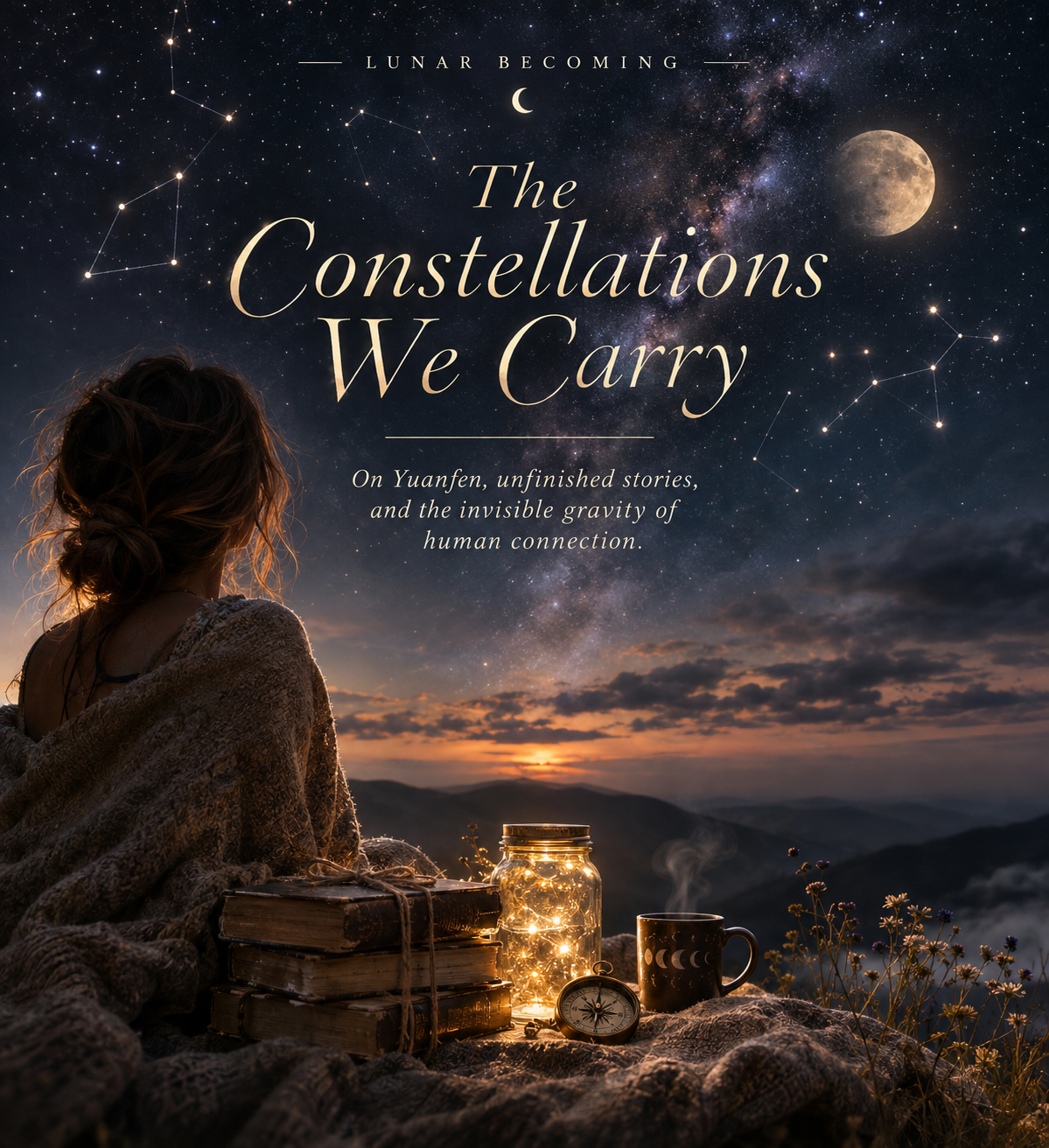
On Yuanfen, unfinished stories, and the invisible gravity of human connection.
There is a Chinese concept called Yuanfen, which describes the mysterious affinity that brings certain people into our lives. The idea that two people can find themselves connected through circumstances that feel almost impossibly deliberate, yet never be promised a lifetime together. That perhaps the meeting and the staying are two entirely different things. I’ve been sitting with that thought lately.. more specifically, I’ve been thinking about the people who come into our lives, rearrange the furniture in our minds, leave fingerprints on the very architecture of who we become, and then, for one reason or another, disappear. Some leave quietly. Some leave without warning. Others remain somewhere in the world, living lives that no longer intersect with ours. And some, perhaps the cruelest kind of absence, leave us with a story that never really had the opportunity to begin. Yet somehow, they all have a way of staying.
I’ve always found it fascinating how human beings measure the significance of a relationship by its duration. We celebrate decades together, anniversaries, milestones, and the accumulation of shared experiences, as though time itself is the greatest testament to love. But what about the people who occupied only a fraction of our lives and somehow managed to change the entire trajectory of them? What about the person who knew you before you knew yourself? The one who saw something in you that you hadn’t yet discovered, or perhaps saw something you were too stubborn to acknowledge? What about the person whose presence felt strangely familiar, almost instinctive, as though your lives had been acquainted long before you ever exchanged names? And what about the people who return? After years of silence, after life has moved forward and the dust has settled, sometimes a person finds their way back into your orbit. A conversation happens. Old wounds are acknowledged. Familiar laughter fills the space between two people who have become strangers in almost every practical sense, yet somehow still recognize each other. Then, just as unexpectedly, they’re gone again. Sometimes permanently.
I’ve experienced enough of these peculiar intersections to question whether the universe has an unusually dark sense of humor. The timing of certain encounters has felt so extraordinary that calling them coincidences almost seems insulting. As though the word itself is too small to hold the weight of what happened. But then again, perhaps that’s the arrogance of being human. Our persistent belief that something so personally significant must have been orchestrated by something greater than ourselves. We are, after all, remarkably talented at making meaning out of chaos. We find faces in clouds, patterns in stars, and messages in the most ordinary occurrences. We assign purpose to suffering because the alternative is uncomfortable, perhaps even unbearable. The possibility that someone can enter our lives, become part of the foundation of who we are, and then disappear without some grand cosmic explanation feels almost offensive to our understanding of existence. Surely there must be a reason. Surely the timing means something. Surely a story that important couldn’t possibly be finished. Or could it?
I’ve often imagined memory as a library. Shelves upon shelves of stories, some beautifully bound and carefully preserved, others tucked away in corners where we pretend they no longer exist. There are books we return to for comfort, books we avoid because their pages still cut a little too deeply, and books we swore we’d burned years ago, only to discover we’ve been carrying their ashes around in our pockets. I have a few of those. Stories whose endings I know by heart, yet somehow I continue to revisit them. Turning the same pages, searching for something I might have missed. A different perspective, a softer interpretation, perhaps an explanation that makes the ending feel less final. Sometimes I wonder whether I’m looking for answers or simply visiting a version of myself that no longer exists.
There’s something peculiar about nostalgia. It has a remarkable ability to preserve the warmth of a moment while quietly rearranging the furniture around its imperfections. We remember the laughter, the familiarity, the feeling of having the world in our hands. We remember who we were before we understood how easily everything could change. And then comes hindsight, that terribly smug companion who arrives years too late with all the answers. We begin rewriting conversations, reconsidering decisions, and imagining alternate endings. We wonder whether a different choice, a little more patience, or a slightly less stubborn version of ourselves might have changed the outcome. Perhaps it would have. Perhaps it wouldn’t. The uncomfortable truth is that we’ll never know.
Psychology has a name for some of this. Counterfactual thinking, the tendency to imagine how our lives might have unfolded differently. There is also the Zeigarnik effect, a phenomenon associated with our tendency to remember interrupted tasks, although its application to unfinished relationships is more metaphorical than established science. But I wonder whether these explanations, as useful as they are, capture the entirety of what it means to carry another person within you. Because not every lingering connection is an unanswered question. Not every memory is a wound waiting to heal. And not every person we think about is someone we secretly wish would return. Sometimes we simply miss them. Sometimes we miss the person we were when they existed beside us. Sometimes we miss the future we once imagined, even if that future was never particularly realistic. And sometimes we miss the ordinary things. The sound of a laugh, the familiarity of a voice, the way someone could make the world feel a little less heavy without ever realizing they were doing it.
There are people who seem to carry sunlight within them. The yellow in the sun, the flowers, and everything in between. People whose existence makes the world feel warmer, more colorful, more forgiving. And when they’re gone, the world doesn’t stop. That’s perhaps one of the strangest cruelties of loss. The traffic continues. The seasons change. People make dinner reservations and complain about the weather. Somewhere, someone is laughing at something entirely insignificant. And you’re left wondering how the world can remain so ordinary when something so extraordinary has disappeared from it. But absence isn’t always death. Sometimes absence is knowing that someone is still out there, beneath the same sky, experiencing the same passage of time, yet existing entirely outside the boundaries of your life. There is no funeral for that kind of loss. No socially recognized period of mourning. No particular moment when the world acknowledges that something meaningful has ended. You simply continue living. And occasionally, perhaps more often than you’d care to admit, you find yourself reaching for that familiar book.
I’ve wondered whether this is what Yuanfen attempts to explain. Not necessarily the existence of invisible threads pulling people toward one another, but the strange reality that connection and permanence are not synonymous. There is a related expression, you yuan wu fen, often understood as having the affinity to meet without the circumstances to remain together. What a painfully beautiful idea. To encounter someone who changes you, perhaps even loves you, and still find that the lives you’re living cannot accommodate one another. We tend to interpret that as failure. A missed opportunity. A wrong turn somewhere along the way. But what if the significance of a connection was never dependent upon its continuation? What if some people are not meant to accompany us through every chapter, but instead become part of the language in which the remaining chapters are written?
And then there’s time. That strange, invisible framework we’ve constructed our entire existence around, despite how little we seem to understand about our experience of it. We speak of the past as though it’s somewhere behind us, the future as though it’s waiting patiently ahead, and the present as though it’s the only place we truly exist. Yet the human mind seems remarkably uninterested in respecting those boundaries. A memory can pull us backward decades in an instant. A familiar scent can resurrect an entire afternoon. A song can make someone who has been absent for years feel closer than the person sitting across from us. We can grieve a future that never happened just as deeply as we mourn a past that did. If time is so neatly divided into what was, what is, and what will be, why does consciousness experience it as something so much less orderly?
Of course, neuroscience offers explanations for how memory and emotion interact. Our brains reconstruct experiences rather than simply replaying perfect recordings of them. Familiar sensory cues activate networks of associations, and emotionally significant events can remain remarkably accessible. But I wonder whether understanding the machinery of an experience necessarily diminishes its mystery. We can explain how light travels across unimaginable distances, yet still find ourselves standing beneath the stars, overwhelmed by the thought that some of what we’re seeing began its journey long before we existed. Perhaps memory is something like that. Not a supernatural window into another time, but a kind of emotional starlight. The original moment has passed, the circumstances that created it may no longer exist, and yet something of it continues reaching us.
And if we’re willing to entertain that metaphor, it raises another question. How much of what we call the present is actually composed of things that no longer exist? The people who shaped our understanding of love, the experiences that taught us fear, the conversations that altered the direction of our lives. We carry them into every decision, every relationship, every new version of ourselves. In that sense, perhaps the past isn’t behind us at all. Perhaps it’s continuously participating in the present, quietly influencing the future without ever announcing itself. Not because time has somehow folded in on itself, but because consciousness refuses to experience life as a collection of neatly separated moments.
I find myself returning to that thought when I consider the peculiar timing of certain goodbyes. Conversations that became final without announcing themselves as such. Reconciliations that arrived just before there would be no more opportunities to reconcile. Ordinary afternoons that transformed into sacred memories only after the future revealed what the present could not. I’ve wondered whether those moments were gifts, coincidences, or something our language simply hasn’t learned how to describe. I don’t know that I believe the universe arranges these encounters. But I also understand why the human heart struggles to accept that they might be random. Perhaps the most difficult part of being human is our ability to recognize meaning in a world that doesn’t promise us explanations.
Carl Jung explored a concept he called synchronicity, the experience of coincidences that feel meaningfully connected despite having no apparent causal relationship. It’s an intriguing idea, not because it proves that the universe is communicating with us, but because it forces us to consider the relationship between an event and the meaning we assign to it. Two people can experience the same coincidence and walk away with entirely different understandings of what occurred. One sees chance. The other sees fate. Neither can necessarily demonstrate that their interpretation captures the whole truth. And perhaps that’s what makes the question so fascinating. Is meaning something we discover in the world, or something consciousness creates in response to it? And if we create it, does that make it any less real?
We want the story to make sense. We want the characters to return when their absence becomes unbearable. We want the author to explain why certain chapters ended so abruptly, why some stories never began, and why the people we would have written into every remaining page were given so few of their own. But life has never been particularly interested in our preferred endings. And maybe that is where the real question begins. If a person is no longer part of our lives, but continues to influence our thoughts, our choices, our understanding of love, and the way we move through the world, have they truly left? Or have we been confusing physical absence with the end of a connection?
There is a concept in grief psychology called continuing bonds, which recognizes that our relationships with those who have died can continue internally, through memory, identity, and the ways their influence remains present in our lives. I wonder whether something similar happens with all profound human connections. Perhaps we are less like individual books and more like collections of borrowed passages. Sentences written by people who loved us, paragraphs shaped by people who challenged us, entire chapters influenced by people who may never know the extent of their contribution. We carry their words, their habits, their tenderness, sometimes even their mistakes. And somewhere along the way, those fragments become indistinguishable from ourselves.
Which raises an uncomfortable possibility. Perhaps the reason certain people remain at the forefront of our minds isn’t because the universe intends to reunite us. Perhaps it’s because they’ve already become part of us. Their story may have ended in the physical world, but its influence continues unfolding through ours. Perhaps what we experience as an unfinished connection is sometimes simply the ongoing consequence of having been profoundly changed by another human being.
Still, I can’t help wondering whether some books really are unfinished. Whether there are people who will cross our paths again, years from now, when the circumstances are different and the characters have grown into versions of themselves capable of understanding what they couldn’t before. Or whether that possibility is simply another story we tell ourselves to make uncertainty easier to carry. Maybe both can be true. Maybe we can accept an ending without pretending we understand it. Maybe we can cherish a memory without needing to resurrect it. Maybe we can love people who are no longer ours to love in any conventional sense, without allowing that love to prevent us from living the life unfolding in front of us.
And perhaps, just perhaps, the existence of an unfinished feeling doesn’t necessarily mean the existence of an unfinished destiny. I think about that when I find myself mentally wandering through the past, turning pages I’ve read a thousand times, searching for something new in words that haven’t changed. The story is the same, but I’m not. And perhaps that’s why I keep finding something different. Maybe the purpose of returning to those pages isn’t to change the ending. Maybe it’s to understand how much the reader has changed since the last time they opened the book.
I don’t know whether Yuanfen is an explanation for the people who enter and leave our lives, or simply a beautiful way of describing the extraordinary complexity of human connection. I don’t know whether consciousness is anything more than the remarkable activity of a physical brain, or whether there are dimensions of subjective experience we have yet to understand. And I certainly don’t know whether the universe has any interest in whom we love, whom we lose, or the peculiar timing of our encounters. But I do know that some people leave us with memories. Others leave us with questions. A rare few leave us with an entirely different understanding of what it means to be alive. And perhaps the most profound connections are the ones that somehow manage to leave us with all three.
Perhaps we are constellations of everyone we’ve ever loved, lost, or almost known. Some stars remain close enough to illuminate our present, while others have long since disappeared beyond the horizon of our lives. Yet we continue drawing lines between them, searching for patterns, assigning meaning, and trying to understand the shape of who we’ve become. Maybe the universe never intended those stars to form a picture. Maybe the constellations were ours to create all along.
And perhaps the question was never whether those people were meant to stay, but whether we would recognize ourselves at all without the light they left behind.


Leave a Reply